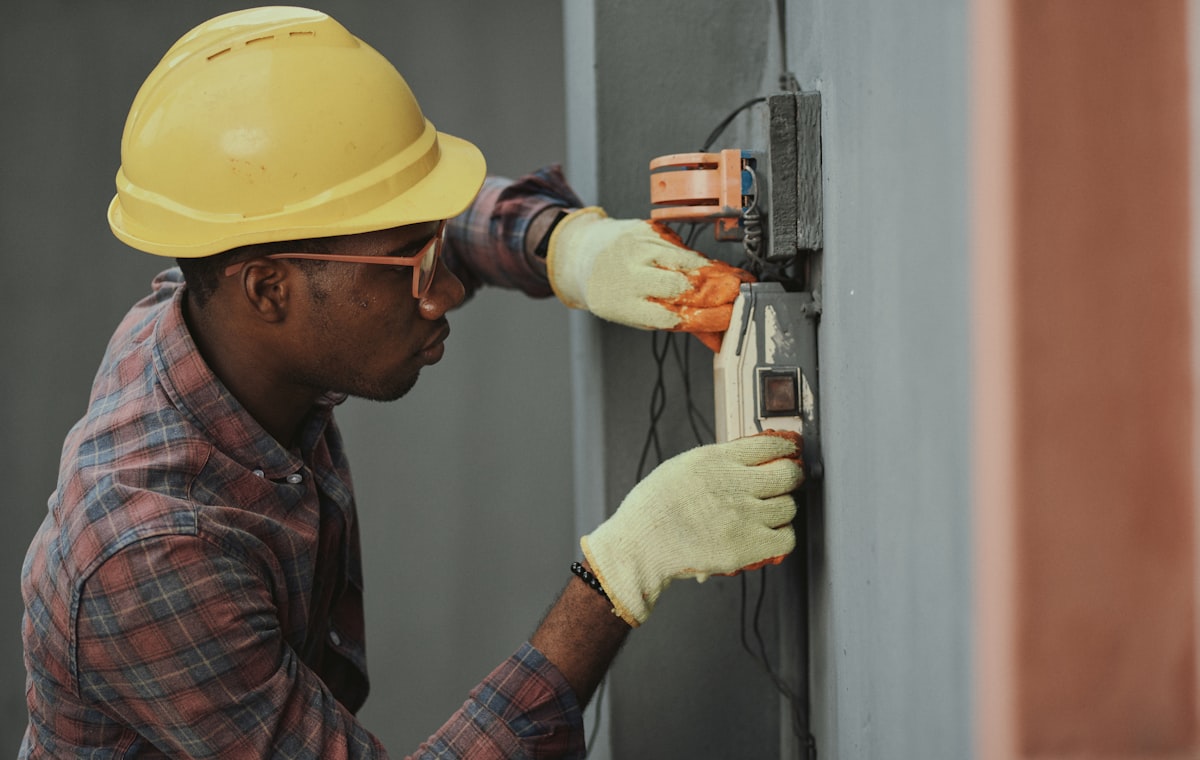
Field service management software has a clear centre of gravity. Jobber, Housecall Pro, ServiceTitan and FieldEdge are designed for plumbers, electricians, HVAC and similar trades doing residential and light commercial jobs: book the call, dispatch a technician, quote, invoice, take payment. They do that well and a company in that mould should not build its own.
The further you are from that pattern, the more you fight the software. This guide covers where custom field service software development makes sense, what to build, and what it costs.
What field service software has to do
- Work orders. Capture the job, the site, the asset and what was agreed.
- Scheduling and dispatch. The right person, with the right skills and parts, at the right time.
- A technician mobile app. Job details, checklists, photos, signatures, parts used, time.
- Quoting and invoicing. Price books, estimates on site, payment.
- Assets and history. What is installed where, and everything done to it.
- Customer communication. Booking, reminders, on-the-way notices, a portal.
- Inventory. Van stock, warehouse, parts ordering.
Where off-the-shelf wins
- Residential and light commercial trades with standard call-out jobs.
- Teams under about fifty technicians with simple territories.
- Flat-rate price books and card payments on site.
- Businesses that need to be live this month.
Larger enterprises with an existing CRM often extend it with Salesforce Field Service or Dynamics 365 Field Service. That is a configuration project rather than a build, and is the right route if you are already committed to the platform.
Where custom field service software wins
1. Equipment-centric service
Medical devices, lifts, industrial machinery, fire systems, commercial refrigeration. The asset is the centre of the job: serial numbers, service intervals, parts compatibility, calibration records and compliance certificates. Trade-focused platforms treat the asset as a note on the customer.
2. Contracts and service levels
Planned maintenance schedules generated from contracts, response and fix-time targets with escalation, and billing that depends on what the contract covers. This logic is specific to how you sell service.
3. Dispatch rules nobody else has
Certifications, security clearances, site inductions, union rules, crew composition, travel across regions, subcontractor allocation. When the dispatcher's real knowledge lives in their head, it can be encoded in a scheduling engine built for it.
4. Offline-first technician apps
Plant rooms, basements, rural sites and mines have no signal. An app that works fully offline and syncs cleanly later, with forms that match your inspection and compliance requirements, is one of the most valuable custom pieces.
5. Integration with what you already run
An ERP for stock and finance, IoT monitoring that should raise work orders on its own, a customer's procurement portal you must invoice through. Custom software bends to these; packaged tools often cannot.
6. Subcontractor networks
Assigning jobs to third parties, checking their insurance and qualifications, capturing their evidence and paying them, without giving them seats in your core system.
What custom field service software costs
| Build | What it does | Typical range |
|---|---|---|
| Technician mobile app | Jobs, forms, photos, signatures, offline sync | $35k-$90k |
| Work order and dispatch system | Jobs, scheduling board, skills, routing | $50k-$120k |
| Asset and maintenance management | Asset register, service plans, history, compliance | $40k-$100k |
| Quoting, invoicing and customer portal | Estimates, approvals, payment, self-service | $30k-$80k |
| Full field service platform | All of the above with inventory and integrations | $120k-$300k+ |
A first version covering work orders, dispatch and a mobile app typically takes three to four months. Many companies begin with the mobile app alone, on top of the system they already use.
Requirements that consistently matter
- Offline behaviour and conflict handling. Decide what happens when two people edit the same job without a connection.
- Speed in the field. Big buttons, few screens, barcode and photo capture.
- Scheduling that explains itself. Dispatchers override systems they do not understand.
- Evidence. Timestamps, location, photos and signatures that stand up in a dispute.
- Integrations. Accounting, ERP, mapping, payments, messaging. Budget for each.
The build-vs-buy test
- Is your work centred on the customer visit or on the asset? Asset-centred work points to custom.
- Do contracts and service levels drive your schedule?
- How much of dispatch is tribal knowledge?
- Do technicians work without signal?
- Is per-technician licensing becoming a major cost?
See what we build on the field services software page, including field service management, the work order system, technician mobile app and asset management. For the app side, read what a custom mobile app costs, or price your scope with the cost calculator.
Frequently asked questions
What is custom field service software?
Field service management software built around one company's operation: its work orders, dispatch rules, assets, contracts and technician workflows. It is used when packaged platforms designed for residential trades do not fit, for example equipment servicing, contract maintenance with service levels, or work in sites with no connectivity.
How much does custom field service management software development cost?
A technician mobile app typically costs $35k to $90k and a work order and dispatch system $50k to $120k. A full platform with assets, quoting, customer portal, inventory and integrations is usually $120k to $300k or more.
Should we use ServiceTitan or Jobber, or build custom?
Use a packaged platform if you run a residential or light commercial trade business with standard call-out jobs. Consider custom if your work is centred on equipment and service contracts, if dispatch depends on rules those platforms cannot express, if technicians need a fully offline app, or if per-technician licensing has become a major cost.
How long does it take to build field service software?
A first version with work orders, scheduling and a technician app typically takes three to four months. A mobile app added on top of an existing system can be delivered faster, and a full platform is usually rolled out in phases.